
Flying with Kids
*information is current as at February 2026. Please check the airline’s website for up to date details.
Flying with a baby or toddler can feel like a military operation. We’ve pulled together all the major Australian airlines’ policies on what you can bring on board, check-in and more when flying with kids – in parent-friendly format.
First thing’s first
First up, booking that plane ticket.
All major Aussie airlines allow infants under 2 years of age (23 months to be exact) to sit on a parent’s lap for domestic flights, meaning you don’t need to book a seat for your baby. Small exception though – if only one adult is travelling with two infants, a seat must be purchased for the second infant.
When on board, you’ll buckle up as usual, and will be given a seatbelt extender to wrap around your baby.
From 2 years old upwards, your child must have their own seat.
So, get those holidays in before they turn two!
Bringing prams on board
All of the major airlines, including Qantas, Jetstar and Virgin Australia, allow a collapsible pram to be brought as a carry-on and stowed in the overhead locker if, when folded, it’s 7kg or less and fits 56cm x 36cm x 23cm. Some exceptions apply for smaller aircrafts, and regional airlines, like Rex, have smaller capacity so it’s unlikely a collapsible pram will fit.
It’s worth noting that the pram will count as part of the accompanying adult’s carry-on, so make sure you don’t exceed this as you may have to check it in.
Any prams or strollers larger than this need to be checked-in, and all of the major Aussie airlines allow one pram per child to be checked in for free.
Portacots
Portacots must be checked-in, but the good news is that all major Australian airlines allow them to be checked in for free.
Qantas permits the following items to be checked free of charge:
Infants (under 2): up to three infant items — collapsible stroller/pushchair, portable cot/bassinet, and car seat/baby capsule.
Children (2–11): up to two child items — car seat, collapsible stroller/pushchair, and/or portable cot/bassinet.
Virgin allows special infant/child items as checked baggage free of charge. Infants can check up to three special infant items (including pram/stroller and portable cot), and children can check two special equipment items (including pram/stroller and portable cot). Fare type can affect the exact mix.
With an infant or small child on the booking, Jetstar allows certain children’s items as free checked baggage, including a stroller/pram, portable cot and bedding, and a car seat/baby capsule/booster seat.
Car seats onboard
If you’re bringing a car seat along for your travels, you may be able to bring it on board – depending on your seat location and with the airline’s prior permission.
Qantas permits approved car seats and CARES-type harnesses on certain aircraft, but booster seats are not. Seating is restricted (e.g., not exit rows) and crew can refuse non‑compliant setups.
Jetstar allows an approved car seat to be brought onboard (and it doesn’t count toward carry‑on). If your child has a purchased seat, you must contact Jetstar to add it, and it must be fitted in a window seat (not exit rows). Booster seats can’t be used in flight.
Virgin accepts certified child restraint systems (car seats and some harnesses) that meet labelling and fit criteria. Infants occupying their own seat must use an approved restraint.
Rex accepts selected forward‑facing infant car seats (up to 18kg) that meet AS/NZS 1754 (and some overseas standards). To use a car seat onboard, you must purchase a seat and tell staff at check‑in. Rex also notes baby capsules and booster seats aren’t permitted for use in the cabin.
In short, always call the airline ahead to make sure you can bring your car seat on board.
Sleepers and seat extenders
The most sleep-friendly airline when it comes to sleepers and seat extenders is Virgin. Virgin allows certain kids’ sleeping devices (including Plane Pal, Fly Tot and JetKids BedBox) with safety rules: set up only when the seatbelt sign is off, stow for taxi/takeoff/landing, don’t attach to the aircraft, and don’t impact other passengers.
Qantas and Jetstar prohibit devices that attach to seats, sit between seats, or block row/aisle access (including bed boxes, inflatable cubes and leg hammocks).
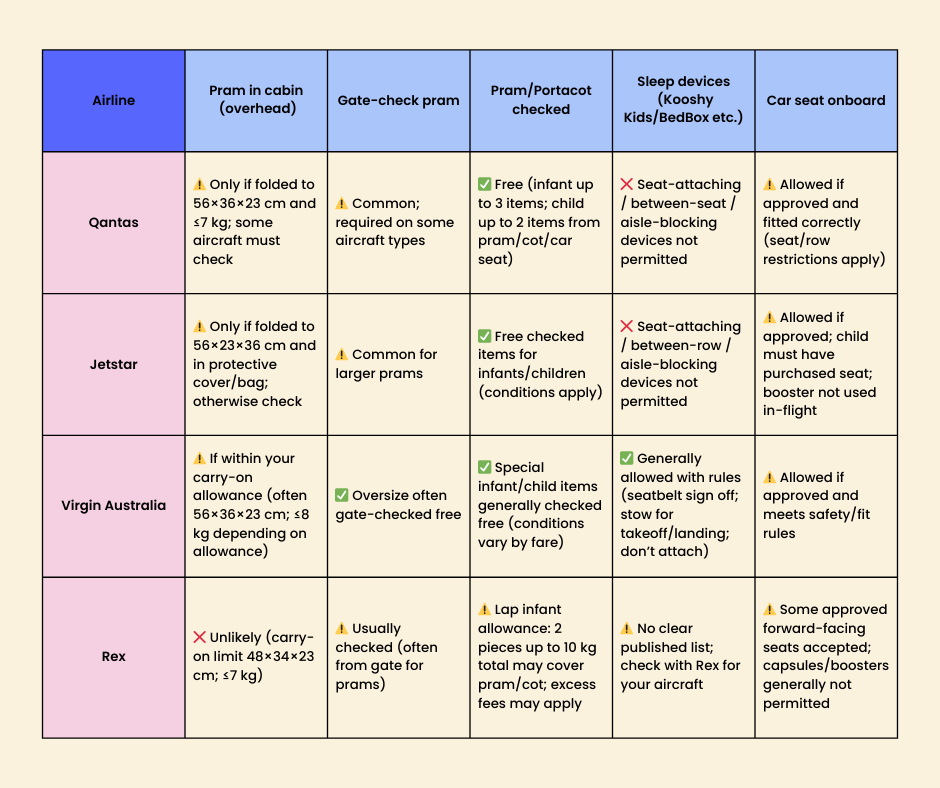
To summarise:
A quick scan guide for Qantas, Jetstar, Virgin Australia and Rex. Always check your specific flight and aircraft on the day.
Legend: ✅ allowed / included • ⚠️ allowed with limits or aircraft/booking rules • ❌ not allowed / generally not permitted • Gate-check = staff take it at the gate and return it at arrival (common for prams).
Quick reminders
Despite the above, gate checking is common even when cabin strollers are allowed. You might find that the flight is booked out with multiple families travelling, and you’re told to check-in your gear at the last minute.
If you’d rather not fly with baby equipment and risk the stress, take a look at Travel Tots’ base package – which includes a portacot, pram, highchair or floorseat – and move through the airport with less gear.